
The new entertainment standard, BS EN 17206:2020 titled Entertainment technology.Machinery for stages and other production areas. Safety requirements and inspections was published in June 2020 and replaces the previous entertainment standards BS 7906-1:2005 and BS 7905-1:2001. B.1 General The following use cases (see Table B.1 to Table B.3) are defined to reflect common machinery risk scenarios ranging from relatively low to high. For each use case, guidance on the safety functions to be implemented is given in Annex C. B.2 Upper machinery
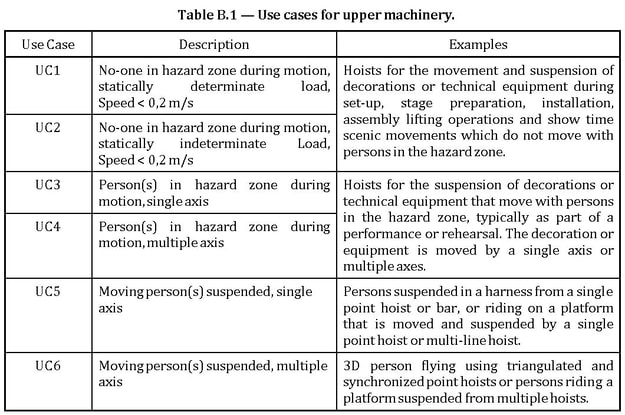
SD – Statically determinate load system In statically determinate load systems all loads and reactions (applied loads of the individual axes and therefore of the suspension points) are known. Examples of statically determinate load systems include: loads on individual axes (point load or multi-line winch); distributed loads on two axes.
Recommended safety functions and measures C.1 General The following Table C.1 to Table C.3 contain guidance on the most common safety functions to be considered for a range of machinery movement use cases. For each use case guidance on the safety functions to be implemented is given based on a generic risk assessment. The machinery designer should consider the following non-exhaustive lists of safety functions but is still responsible for performing their own risk assessment and should consider additional safety functions to address specific hazards. Key: — The safety function has no recommendation for or against being used; R The safety function is recommended for this use case; HR The safety function is highly recommended for this use case. If this safety function is not implemented, then the rationale behind not using it should be detailed. C.2 Upper machinery
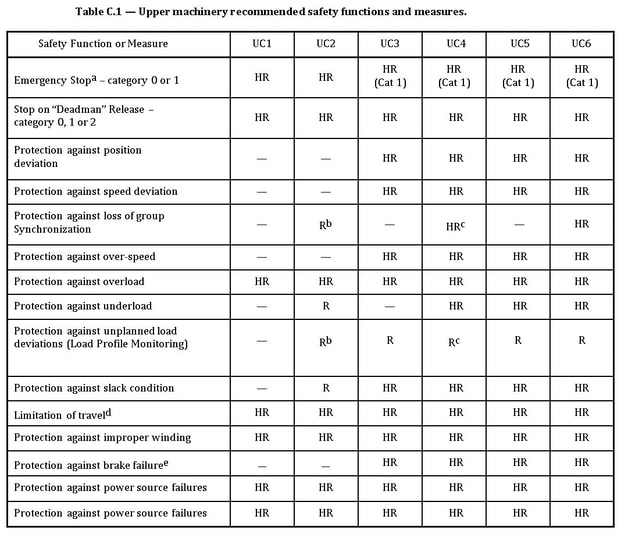
a Although it is sometimes argued that an Emergency stop is not a safety function, in the context of stage machinery it could be considered part of the operator safety loop. b UC2 – either Loss of Group Synchronisation or Overload Protection shall be provided. c UC4 – either Loss of Group Synchronisation or Overload Protection shall be provided. d Required only where over travel could result in mechanical damage or failure. e Protection against brake failure includes brake air-gap monitoring and similar technologies. Manual inspection of brakes to ensure their safety shall always be undertaken for all classes of machine.
Chain hoist industrial-grade Electric chain motors D8 The D8 motor corresponds to a standard industrial electric chain hoist in accordance with EN14492-2 and IGVW SQP2:2018 with the difference that the D8 motor is usually used without a handheld controller and in mobile event technology climbing on its chain. As an additional securing measure, the installation of a secondary safety component is required to fix the load. GIS motors in D8 execution are applicable as climbing or stationary hoists without modification up to 3200 kg lifting capacity in single fall operation or 6300 kg in double fall operation. A second, independent brake can be assembled to the hoist in a few simple steps.
Electric chain motors D8+ The GIS motor in D8 Plus version is an electric chain hoist which is specifically developped, rated and designed for holding loads above people. It is light and compact in design and thus perfectly suited for mobile use. All components which are in the flow of forces are statically dimensioned for the double of the nominal rated capacity. D8 Plus motors are suitable for climbing and stationary hoists without any modifications. The maximum lifting capacity in single fall execution is 2500 kg at a chain safety factor of minimum 8:1in accordance with EN14492-2, IGVW SQP2:2018 and EN17206.
Electric chain motors C1 The GIS motor in C1 version is an electric chain hoist which is specifically developped, rated and designed for holding and moving loads above people. It is light and compact in design and thus perfectly suited for mobile use and responds to the requirements in accordance with EN14492-2, IGVW SQP2:2018 and EN17206. Due to the modular design of the GIS chain hoist, the path and load measurement can be implemented in a simple way. Encoders for path measurement can be mounted on the chain wheel or on the rotor shaft. Due to the high power reserve of the motors, the chain hoists have an excellent synchronisation during group movements. GIS motors in C1 version also cover high lifting speeds up to 32 m/min. (50 Hz)